Proxmox VE Networking and Security Guide
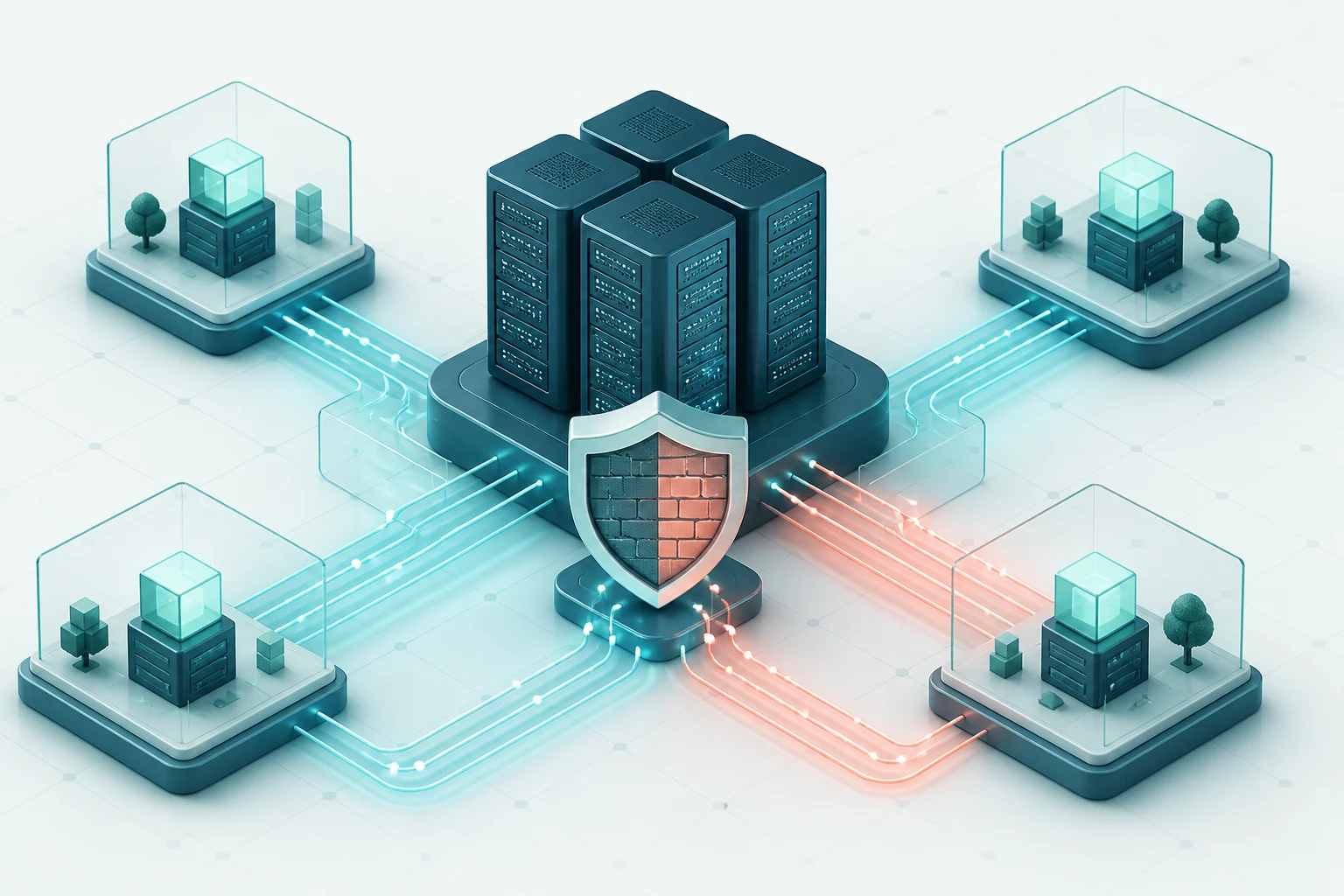
Virtualization networking carries several kinds of trust through the same servers. Administrative sessions, cluster messages, storage I/O, migration streams, backup data, guest traffic, and public services have different consequences if they are exposed or interrupted. Proxmox VE provides bridges, bonds, VLANs, firewall controls, and software-defined networking features, but a secure design begins by separating purposes.
Map every traffic class
Draw the path for management, Corosync, storage, migration, backup, guest, and out-of-band management traffic. Identify the source, destination, protocol, expected bandwidth, latency sensitivity, and responsible owner. Include switch management and external services such as DNS, NTP, identity providers, monitoring, and update repositories.
This map reveals dependencies that a simple VLAN list misses. A host may have several logical networks on one physical uplink, or a backup service may depend on routing through a firewall maintained by another team. Record those relationships so a change review can predict the effect of a failed link or incorrect route.
Protect the management plane
The web interface and administrative APIs should not be exposed directly to the public Internet. Limit access to trusted administrative networks, a controlled VPN, or a dedicated access path. Use individual accounts, strong authentication, and multi-factor authentication where supported. Shared root credentials remove accountability and make safe revocation difficult.
Role-based access control should match job duties. A backup operator, guest administrator, and cluster engineer do not need identical permissions. Use API tokens with limited scope for automation, store secrets in an approved system, and review unused accounts and tokens. Emergency access should be documented, protected, and tested without becoming the everyday shortcut.
Use trusted certificates and consistent names
Administrators should reach the interface through expected hostnames and valid certificates. Ignoring certificate warnings trains people to accept interception or configuration errors. Maintain DNS, certificate renewal, and time synchronization as platform dependencies, then alert before certificates expire.
Record the intended address for every node and do not casually change cluster names or addresses after deployment. Some changes affect cluster communication, certificates, and storage references. Follow the documentation for the installed version and use an independent console path before modifying network configuration remotely.
Understand Linux bridges and VLANs
A Linux bridge behaves like a virtual switch connecting guest interfaces to physical or internal networks. Keep bridge names and purposes consistent across nodes so migrations do not attach a guest to an unintended network. A bridge without a physical port can provide an isolated segment for appliances or test systems, but routing and security policy still need explicit owners.
VLAN-aware bridges can carry several tagged networks over one uplink. Verify allowed VLANs at the host and switch, avoid an unplanned native VLAN, and document whether guest interfaces receive tagged or untagged traffic. Segmentation reduces reachability; it does not encrypt traffic or guarantee bandwidth.
Design bonds for the actual switch topology
Network bonding can provide link redundancy and, for multiple flows, additional aggregate throughput. The selected mode must match the switch configuration. Link aggregation across two switches requires a switch design that supports a single logical group; otherwise a seemingly redundant configuration can create loops or black holes.
Test failure of each cable, interface, switch member, and upstream path while monitoring packet loss and guest impact. One successful ping does not prove that storage sessions, migration, or long-lived application connections recover correctly. Record the convergence time and compare it with service requirements.
Keep cluster communication predictable
Corosync needs reliable, low-latency communication. Give it a path that will not be saturated by migrations or backups, and consider redundant links appropriate to the cluster design. Monitor packet loss and latency on the real path. A heavily congested network can threaten quorum decisions even though every node remains otherwise healthy.
Do not route cluster traffic through unnecessary security devices or long-distance links without validating support and latency behavior. A stretched cluster introduces failure modes involving distance, storage consistency, and site isolation that require specialized design rather than ordinary VLAN extension.
Secure storage, migration, and backup paths
Storage traffic may contain complete guest data, while migration can expose memory state and backup networks carry historical copies. Restrict these networks to the nodes and services that require them. Use encryption where the technology and risk model call for it, and avoid assuming that a private address range is automatically trusted.
Capacity and security interact. If every traffic class shares one uplink, an attacker or accidental workload burst can degrade cluster and storage communication. Rate limits, quality of service, dedicated links, and monitoring can make separation meaningful. The exact combination depends on scale and switch capability.
Apply the Proxmox VE firewall in layers
Firewall policy can be defined at data-center, node, and guest levels. Start with an inventory of required flows and build policy in a controlled sequence. Use groups or reusable constructs for common services, apply logging selectively, and avoid a rule set so noisy that important events disappear.
Test changes from a separate session and keep out-of-band access available. Confirm both allowed and denied paths. Host firewall rules do not replace upstream controls, guest operating-system firewalls, or application authentication; layered controls reduce the effect of one mistake.
Control public and tenant-facing guests
Place public services in networks with explicit routing and limited access to internal systems. Do not attach an Internet-facing guest to the management bridge for convenience. In multi-tenant environments, consider address spoofing, lateral movement, broadcast behavior, and who can change guest interfaces.
Templates and automation should create secure defaults: the right bridge, expected VLAN, guest firewall state, and monitoring registration. A manual exception should have an owner and an expiration date. If you are assessing the platform, the Proxmox VE ISO page gives a broader overview without replacing the official networking documentation.
Monitor and rehearse network changes
Collect interface errors, drops, bond state, bridge state, latency, throughput, firewall events, and switch telemetry. Build a baseline during normal operation and maintenance. Sudden packet loss or retransmission may explain storage and cluster symptoms that appear unrelated in the guest interface.
Review changes before applying them across every node. Test one path, confirm cluster and storage health, and maintain a rollback method that works if remote access disappears. A secure Proxmox VE network is understandable under pressure: operators know which path carries each service, which controls apply, and how to recover from a mistake.